

Be careful on the way to school: hidden dangers on the roads in September and how to protect yourself from them
28.08.2026
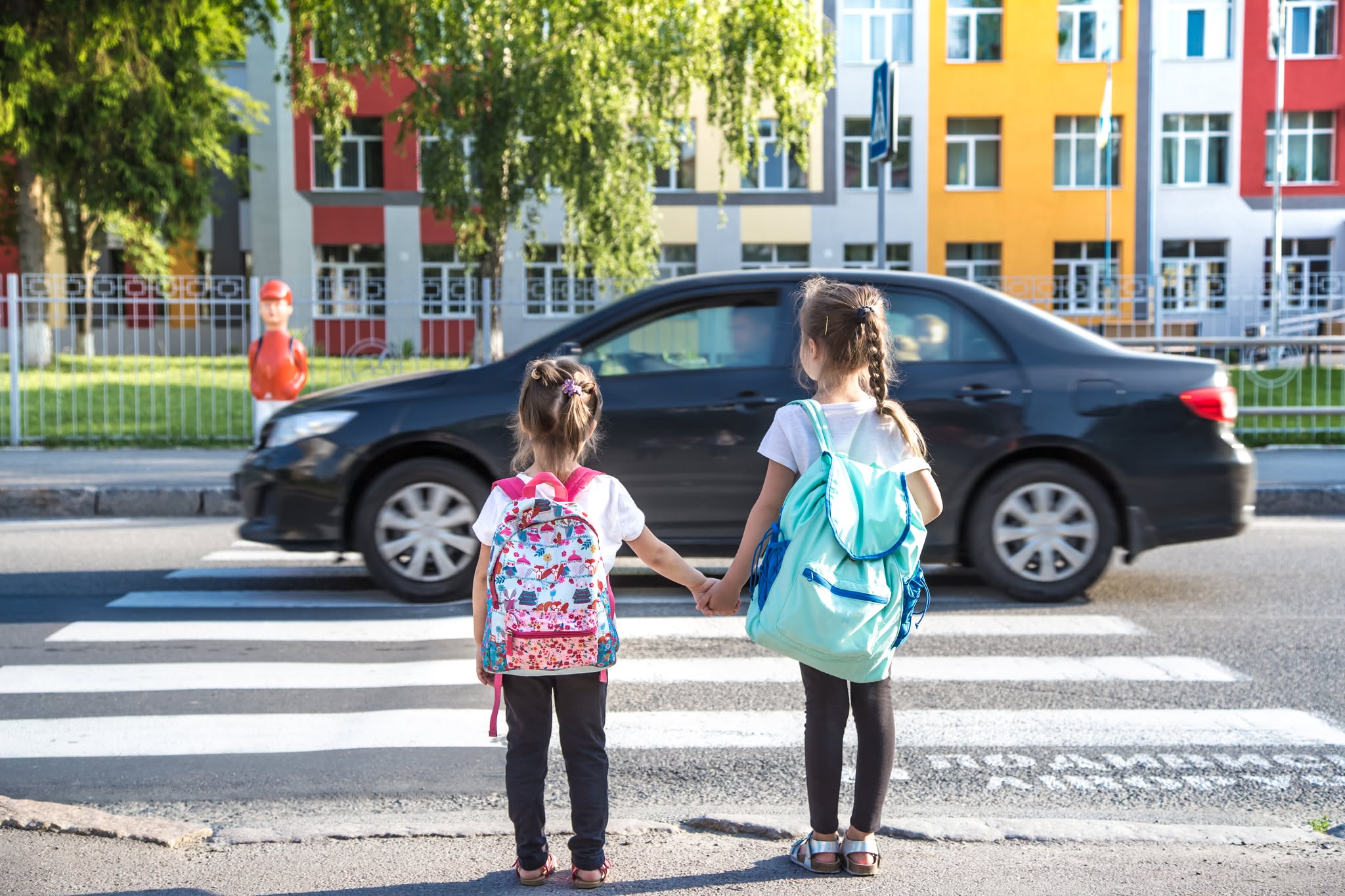
With the start of the new school year, city streets become more chaotic. Parents are rushing to drop their children off at school, drivers are trying to get used to the traffic jams after the summer lull, and schoolchildren have not yet adapted to the heavy traffic.
It would seem that everyone knows the basic rules of the road. However, injury statistics show that danger often lurks where we feel most at ease. To help you minimise the risks, we have put together a selection of less obvious facts and insights that will help you look at children’s road safety in a different light. As there are as yet no large-scale local studies on this topic, we will draw on examples from international experience. After all, road traffic operates according to similar principles everywhere, and children’s behaviour and reactions are the same in any country.
The ‘invisible child’ phenomenon and the dangers of blind spots
Many parents fear that their child might be hit by a car speeding down the street. But there is another, hidden danger — accidents involving vehicles reversing.
- Fact: according to the organisation Kids and Car Safety, around 50 children are hit by reversing cars every week in the US. Because of a child’s short stature, they are simply not visible in the rear-view mirror or on the camera, especially if other large vehicles are parked nearby. The blind spot behind a car can extend up to 4–7 metres. The danger increases in autumn, when it starts to get dark earlier. A child wearing a dark jacket blends in with the tarmac, leaving the driver with very little time to react.
- Solution: Drivers are advised to fit a rear-view camera if their car is not already equipped with one. Parents should teach their children the ‘Moving Wheels’ rule (if a parked car’s reversing lights are on or the engine can be heard, they must move away immediately). And most importantly: reflective elements on rucksacks and clothing are not a fad, but a necessity that increases a pedestrian’s visibility from 30 to 150 metres.
The illusion of safety: school zones as hotbeds of chaos
The area around a school, with its bright signs and speed bumps, seems like the safest place. However, critical situations often arise there too.
- Fact: a large-scale study by Safe Kids Worldwide (USA) found that one in three drivers behaves dangerously precisely in the drop-off and pick-up zones near schools. And the worst thing is that the chaos is caused by the parents themselves, who are in a hurry. They park in double rows, block pedestrian crossings, get distracted by their phones, or drop their children off right onto the carriageway.
- Solution: if you’re dropping your child off at school, don’t become a hazard. Only let your child out on the pavement side and never let them run across the road between parked cars — they’ll appear completely out of the blue to other drivers.
The ‘screen’ effect at multi-lane crossings
The rule ‘cross at the zebra crossing when the light is green’ works, but children often do not understand the nuances of crossing multi-lane roads.
- Fact: a study by the New York City Department of Transportation showed that infrastructure measures (such as traffic islands, which force drivers to slow down) reduce injuries among schoolchildren by 44 per cent. However, on ordinary wide roads, children can fall victim to the ‘screen effect’. They assess safety in a linear way: if a large vehicle in the front row has stopped before the zebra crossing, the child starts to run. They do not realise that the vehicle in the second row might not stop, because the driver simply cannot see them behind the first vehicle.
- Solution: Teach your child to follow the rule of eye contact. Specifically, never step onto the next lane until they have looked at the driver and made sure that the driver can see them (by nodding, gesturing, etc.) and has stopped.
Children’s recklessness and the strict letter of the law
Even if you are the most attentive driver travelling at 30 km/h, a child may run out onto the road completely unexpectedly. And here it is important to bear in mind the nuances of the law.
According to Article 1187 of the Civil Code of Ukraine, a car is a ‘source of increased danger’. In practice, this means that the driver is financially liable for the pedestrian’s medical treatment, even if the accident was caused by the child themselves, who was crossing the road in a prohibited place. Compensation for medical expenses in such cases can become an unexpected and significant financial burden for the driver.
To avoid unpleasant financial consequences and resolve the situation amicably, without unnecessary stress, drivers should have enhanced insurance cover. We recommend taking out a policy with extended liability cover — MTPL Plus from Euroins, which provides better compensation for victims’ losses.
And parents of schoolchildren should consider taking out an accident insurance policy for their children — it will cover the costs of treating injuries sustained not only on the road, but also during school breaks or at sports clubs.
Be careful on the roads, talk to your children about safety, and leave the risks to the professionals. We wish you a safe autumn!