

Pedestrians on the road: how to avoid falling victim to hidden hazards
24.04.2026
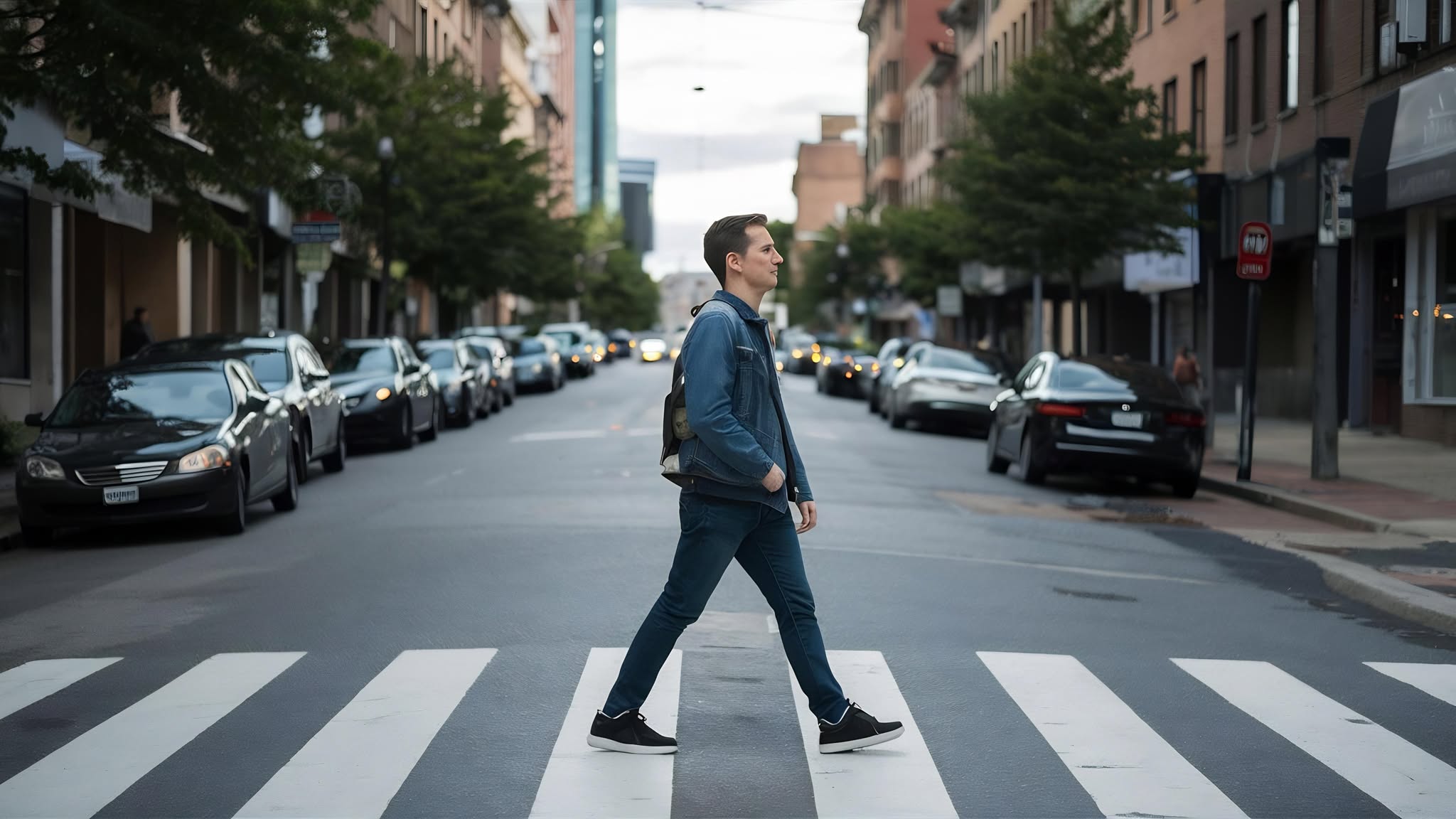
Imagine: you’re driving calmly through town, and suddenly a person wearing headphones appears in front of your car. You have just one and a half seconds to react, and you’ll be lucky if you manage to brake in time. And if not – who will pay for the mistake: the driver or the pedestrian? And what role does an insurance policy play in this situation?
‘Smombies’ all around us: when the road becomes a portal
Surely every driver has seen this scene at least once: a person in a deep hood, wearing headphones and with their gaze fixed on their smartphone, steps onto the road without even glancing to the side. The ‘smartphone zombie’ phenomenon, or ‘Smombies’ for short, has long ceased to be just a joke on social media. We’re talking about pedestrians who are so immersed in the virtual world that the reality around them, with its engine noise and headlights, simply ceases to exist for them. For such a person, stepping from the pavement onto the road is like stepping through a portal – they often don’t even realise they’ve moved from the pavement into a high-risk zone.
In spring, the situation becomes even more acute, as our bodies react more slowly to everything. Added to the general spring fatigue is chronic sleep deprivation caused by night-time air raid alerts and shelling, which have become our daily reality. When the brain is operating in energy-saving mode, attention wanders instantly.
Statistics confirm this: up to 35% of pedestrians are distracted by their gadgets whilst crossing the road (Midland Trauma System study, 2019). To avoid accidents, drivers have to think for two, trying to anticipate the actions of someone who isn’t even looking in their direction.
The critical one and a half seconds and the ‘three-lane rule’
When a pedestrian suddenly appears in front of a car, physics comes into play. The average driver’s reaction time is around 1.5 seconds. At 50 km/h, a car covers almost 14 metres per second. This means that by the time you even start braking, the car will have travelled 21 metres.
The problem is also that a pedestrian – especially one without headphones or a smartphone – is not always physically able to accurately judge a car’s speed. In twilight or in bright sunlight, the car seems ‘still far away’, even though it has long since entered a zone where it is impossible to stop instantly.
A separate point is clause 4.8 of the Highway Code. Many people forget that it is perfectly legal to cross the road outside a zebra crossing if there is no crossing within sight and the road has no more than three lanes in both directions. In such places, a pedestrian has the right to cross the road at a right angle, having first allowed traffic to pass. But for the driver, this means that a person may appear entirely legally where they are not expecting them. And even if the pedestrian simply misjudged your speed, the burden of the consequences will still fall on your shoulders.
Unobvious legal nuances
Here we come to the most complex issue – Article 1187 of the Civil Code. The law defines a car as a ‘source of increased danger’. This wording makes the car owner financially liable for any harm caused to a pedestrian, regardless of whether the driver was at fault.
Even if the pedestrian has grossly breached the rules by crossing the road in an unauthorised place, the driver may still be obliged to cover the costs of their treatment. The court may only slightly reduce the amount of compensation, taking into account the pedestrian’s carelessness, but it is extremely rare for it to be waived entirely. In such a situation, the driver often finds themselves a hostage to their status as a car owner, forced to answer for other people’s mistakes and miscalculations. It is worth remembering that a pedestrian’s medical treatment can cost hundreds of thousands of hryvnias.
Plan B, or why an insurance policy is your guarantee of peace of mind
How can a driver feel more confident when pedestrians are becoming increasingly unpredictable? At such times, insurance transforms from a mere formality into your real financial shield. The optimal solution is a combination of two tools, each doing its part.
Euroins’ MTPL is your protection in all situations where you are at fault for a road traffic accident, including potentially ambiguous cases involving pedestrians. As the driver bears financial responsibility for the treatment of an injured pedestrian, the insurance company takes care of these payments. This allows you to avoid painful legal proceedings and significant financial costs.
But what about protecting your own car? While mandatory driver's liability insurance covers payments to others, CASCO Classic looks after your vehicle. A collision or hitting a deep pothole can cause serious damage. And having a policy that covers the cost of repairs is the best way to keep your peace of mind.
Driving in spring is always a bit of a gamble. You might know the rules inside out, but you can’t control other people’s sudden decisions. That’s why the best strategy is to be as careful as possible, respect everyone’s right to safety, and always have reliable financial backing from Euroins.